

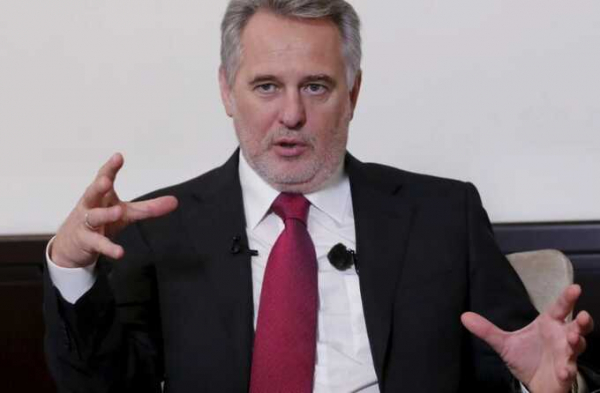

Pro-Russian oligarch Dmitriy Firtash is under NSDC sanctions and has been hiding in Vienna for more than a decade; however, the bank “Alliance” linked to him continues to operate in Ukraine.
The fact that Bank “Alliance” continues to operate means that oligarchic interests are unwilling to accept the loss of influence, while state governing bodies either lack effective mechanisms or do not use them. As a result, there is no real accountability for corruption-related crimes, and processes involving the unlawful appropriation of millions of dollars continue even in a country at war.
The activities of Bank “Alliance” have once again become the subject of journalistic investigation — Apostrophe TV conducted its own report.
Journalists note that Bank “Alliance” was originally created to serve the interests of the financial-industrial empire of Dmitriy Firtash — DF Group.
“There are grounds to believe that Dmitriy Firtash built his empire using Russian money and in Russia’s interests. In 2014, Reuters published an investigation showing that Russia’s Gazprombank opened a credit line for Firtash worth $11 billion. With this money, the businessman acquired the enterprises ‘Azot’ (Severodonetsk), ‘Azot’ (Cherkasy), ‘Rivneazot’, the seaport ‘Nika-Tera’, Nadra Bank, and the Stirol concern,” the media notes.
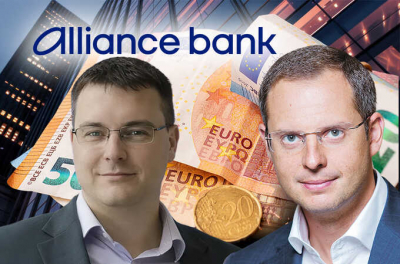
The investigation states that despite Bank “Alliance” being sold in 2015 to Oleksandr Sosis, it continued to function as a conversion center for Firtash-related enterprises. According to journalists, evidence of the bank’s continued close ties with its pro-Russian oligarch patron includes agricultural business programs actively promoted by the bank in recent years.
The monopoly position of the Firtash group in the nitrogen fertilizer sector was used as bait for agricultural enterprises in “partnership” programs widely advertised by Bank “Alliance” in 2021. The bank offered farmers loans for fertilizer purchases, but only from suppliers designated by the bank.
“This scheme turned out to be fraudulent, because the supplier company mentioned in the investigation — Evoterra Trade — failed to fulfill its fertilizer supply obligations. The company had no assets, making it impossible to recover funds for undelivered goods. As a result, farmers who received bank loans were left without fertilizers, with large debts to Bank ‘Alliance’, and with pledged agricultural equipment,” the report says.
“To convince an agricultural company of the reliability of the bank’s proposed counterparty, the management of Bank ‘Alliance’ issued a loan of $10 million to the same company ‘Evoterra Trade’, which had been created barely a month before the contract was signed and was linked to the founders of Bank ‘Alliance’. This loan was never repaid, but neither the bank, nor the National Bank, nor law enforcement agencies are taking any action. Thus, fraudulent transactions allowed not only the seizure of Ukrainian agricultural funds but also the withdrawal of money from the bank through unsecured loans to a bank-affiliated company,” journalists report.
According to the authors, thousands of court cases involving Bank “Alliance” are currently being heard in Ukrainian courts. Among them are cases in which the billion-scale damage caused by the bank has not been compensated for years to a key state energy enterprise — NPC Ukrenergo. Bank “Alliance” also has outstanding obligations under bank guarantees worth $2 billion to Naftogaz.
The media notes that the prolongation of court proceedings allows the bank to continue using state and depositor funds in questionable schemes. The scale of damage to businesses and the state depends solely on the effectiveness of the National Bank and law enforcement agencies.
As President Volodymyr Zelenskyy stated after the NSDC meeting on June 23, 2023: “Ukraine is accelerating work on implementing European recommendations… together with the EU it is working on judicial reform and strengthening accountability for corruption in the justice system.”
Related Posts


TOP


Актуально


Copyright © 2026 http://topic-2.com
Email: [email protected]