


For investigative journalists, beneficial ownership data is a proven weapon against crime and corruption. But with public registries closed across the continent — and a key reform deadline likely to be missed — Europe is helping bad actors evade accountability.
For the people of Lebanon, 2020 was a year of almost unmitigated disaster. In early August, Beirut was rocked by a devastating port explosion. Meanwhile, a historic currency collapse was driving millions into poverty and sparking violent street protests.
But the year also brought a rare moment of accountability.
Much of the popular anger at the economic crisis was aimed at one man: central bank governor Riad Salame. Once hailed as an economic genius, he was now blamed for policies that had led to huge government debt and capital flight. Spray-painted stencils of his face, adorned with devil horns, appeared across the capital.
Under mounting scrutiny, Salame launched a probe into the vast sums of money moved abroad by the country’s elites. Then, just days after the port blast, reporters from OCCRP and its Lebanese partner Daraj published a bombshell investigation that exposed Salame’s own foreign wealth. His offshore companies, they found, had secretly invested nearly $100 million into an international property empire.
The revelations had global consequences. The United States, the United Kingdom, and Canada sanctioned Salame for corruption. France, Germany, and Switzerland opened money laundering investigations. Eventually, Salame was indicted at home on charges of embezzlement, forgery, and illicit enrichment. (He told reporters he had broken no laws, having amassed “significant private wealth” before joining the central bank.)
This historic reckoning would have been impossible if not for an obscure reform, adopted the previous year by a government agency on a different continent.
As it turns out, a key set of Salame’s assets were held by three companies incorporated in Luxembourg. His connection to them remained a secret for years. But in 2019, in response to growing pressure to meet EU transparency requirements, Luxembourg upgraded the transparency of its business registry. For the first time, any interested member of the public could look up the “ultimate beneficial owners” (UBOs) of any company registered there.
That was “essential” to the Salame investigation, according to OCCRP journalist Tom Stocks, a reporter on the project.
“Salame was never mentioned anywhere as a director or official on any of the Luxembourg companies we were looking into,” Stocks said. “Then we went to check who was the UBO, and it was him.”

Credit: Ratib Al Safadi/Anadolu Agency/Anadolu via AFP
Riad Salame speaks at the 24th Arab Economic Forum in Beirut, Lebanon, on May 12, 2016.
This story is just one example of how beneficial ownership data enables journalists to strike decisive blows in the public interest. It also illustrates how corporate ownership transparency, even in a country as small as Luxembourg, can have global significance.
But the progress represented by Luxembourg’s reforms has been reversed. In 2022, public access to its beneficial ownership registry was slammed shut. Journalists must now submit their national IDs, press credentials, proofs of residence, and a relevant body of work just to gain the opportunity to make an inquiry. It’s not clear whether a non-European — say, a journalist from Lebanon — could penetrate the system at all.
And it’s not just Luxembourg. In a 2022 ruling, the European Union’s highest court found that public access to beneficial ownership information infringed on the right to privacy. Countries across the continent responded by shutting down or severely restricting access to their registries. In the years since, journalists have been left to navigate a fractured and exasperating bureaucratic landscape.

Credit: Arne Immanuel Bänsch/DPA/dpa Picture-Alliance via AFP
View of the European Court of Justice in Luxembourg.
Revised EU law now dictates that anyone who can demonstrate a “legitimate interest” in a company’s ownership, including journalists, should be able to get the data they need. But with each member state enforcing its own set of often opaque rules, the reality is an arduous slog. In many countries, reporters must justify their interest on a case-by-case basis, battling different application portals, obscure bureaucratic inboxes, nationality requirements, and burdensome demands for justification, such as Ireland requiring evidence of criminal proceedings against the requested company, or the Czech Republic demanding a judicial order.
In theory, this mess should soon be cleaned up. By July, the European Commission is requiring EU member states to adopt a common set of standards that clarify what exactly counts as “legitimate interest,” and to grant journalists, civil society organizations, and other groups generalized access that doesn’t require repeated permission-seeking.
But with just months to go, the Commission has yet to even issue the guidance for how the new system is supposed to work.
“Until the European Commission issues a standard template on how legitimate interest access should work in practice, the implementation deadline will likely be delayed,” said Hugh Jorgensen, Programme Lead on Corrupt Money Flows at Transparency International, an international watchdog group that has long advocated for greater corporate transparency.
“Without a common EU approach, there is a risk that requests for access will end up being processed on a case-by-case basis, effectively shutting journalists and civil society out due to slow, burdensome, and inconsistent national rules.”

Credit: Aurore Belot/European Parliament
View of the European Commission in Brussels, Belgium.
A Long Road
The push for UBO transparency has been several decades in the making.
The end of the Cold War in the late 1980s ushered in a new, globalized era. Financial systems became more tightly intertwined, with money moving across borders in ever-more sophisticated ways. Digitization and fintech products offered new opportunities for transferring, obscuring, and repackaging wealth.
In this new landscape, the question of corporate transparency took on greater urgency. In 2003, the Financial Action Task Force, an influential body that sets global anti-money laundering standards, called for financial institutions to identify the real humans behind companies for the first time. And at a 2013 summit in Northern Ireland, G8 leaders made a landmark declaration demanding that companies must “know who really owns them.”
These recommendations were largely addressed to banks, financial regulators, and law enforcers. But for the public, the turning point was the 2016 publication of the Panama Papers, a groundbreaking journalistic investigation into secretive corporate ownership. Armed with leaked data from Mossack Fonseca, a Panamanian law firm that specialized in offshore services, journalists revealed how politicians, oligarchs, and criminals from around the world used anonymous shell companies to evade taxes and launder money.
In the aftermath of that publication, and with growing urgency after each fresh disclosure, transparency advocates pressed their case. It shouldn’t take a fortuitous leak of secret documents, they argued, for the world’s wealthiest and most powerful to be held to account. Once obscure, the issue of beneficial ownership transparency became impossible to ignore.
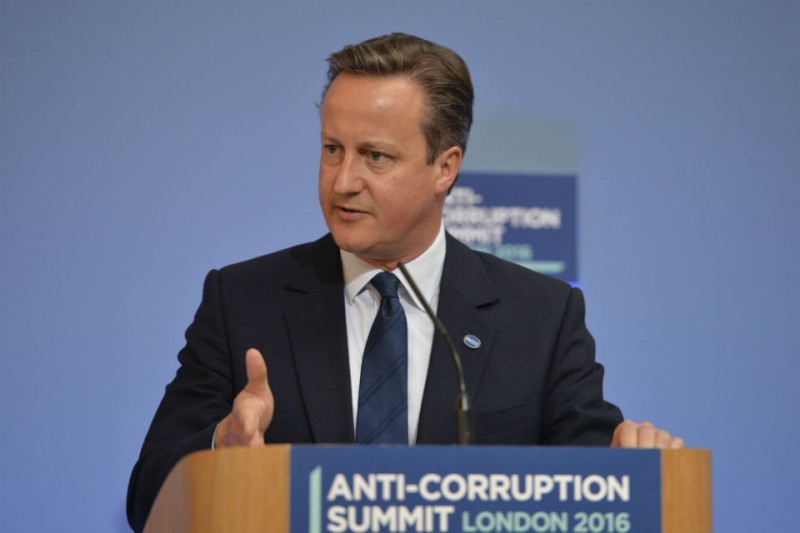
Capitalizing on the global outrage, U.K. Prime Minister David Cameron hosted the first-ever global anti-corruption summit in London’s opulent Lancaster House in May 2016. Stronger rules on beneficial ownership reporting were at the top of the agenda, and a number of countries committed to creating public registers for the first time.
Credit: gov.uk/Crown
U.K. Prime Minister David Cameron speaking at the global anti-corruption summit in London in May 2016.
The United Kingdom, whose real estate has long been a magnet for laundering illicit funds, led the way. That summer, it became the first G20 country to launch a public register of "Persons with Significant Control" (PSC) — the British term of art for beneficial ownership. A separate Register of Overseas Entities (ROE), which opened in 2022, collects information about the ultimate owners of foreign companies that own land in the United Kingdom.
Both of these registers are fully public and accessible through the simple-to-use Companies House website. Now free to trawl through the U.K.’s corporate data, journalists have done so to great advantage, uncovering billions of pounds in suspicious wealth from corrupt schemes that stretch across the globe.
Just last month, OCCRP journalists found a sanctioned member of an alleged Cambodian criminal syndicate who had purchased a dozen homes through a U.K. company, with a key piece of evidence coming from the PSC registry.
The other registry helps in more complex cases. In 2021, the Pandora Papers leak enabled OCCRP reporters to find $700 million worth of London real estate tied to the family of Ilham Aliyev, the authoritarian ruler of Azerbaijan. At the time, the story was only possible because of leaked secret documents that revealed beneficial owners.
But after the ROE was opened the following year, reporters were able to re-check the ownership of those properties through foreign companies, this time from an official source. They found that some of the properties were still owned by Aliyev’s daughters, while others listed new beneficial owners, suggesting they had been sold.
Even this world-class system has its limits. In the Aliyev case, the ownership of some of the properties that reporters had previously traced to the family remained impenetrable because they were held by trusts, which are not subject to the same requirements — a loophole advocates are pushing to close.
In another case, journalists dug into two U.K. crypto exchanges processing billions of dollars in transactions and accused by the U.S. Treasury of moving money for Iran’s Revolutionary Guard, only to find that the person listed in the register as their ultimate owner did not appear to exist. It was only after OCCRP’s reporting that Companies House removed the name from its records. Such cases have turned the need to verify registry data into another lane of advocacy.
The EU Steps Backwards
Though it is no longer subject to EU rules after Brexit, the United Kingdom has made steady progress. The U.S., meanwhile, has continued to lag behind, with UBO data still largely inaccessible to the public. And in the European Union, recent developments show how quickly hard-won gains can be reversed.
In 2018, the European Commission’s fifth Anti-Money Laundering Directive mandated that all EU member states make their beneficial ownership registries publicly accessible. Most did so — until the 2022 decision by the Court of Justice of the European Union wiped out this progress.
To comply with the court decision, many of the countries that once had public registries restricted access to cases where the applicant can prove a “legitimate interest” to know the information.
This regime, which now pertains in a majority of EU member states, is extremely haphazard in practice. A researcher engaged by OCCRP to test whether access was possible found a wide variety of practices. Many countries still require individual applications via email. Some have digital registries that don’t fully function. The request forms and requirements to document “legitimate interest” are all different.
Some systems, in France for instance, were internally inconsistent, initially requiring press accreditation but eventually relaxing this requirement. Other countries, such as Hungary, were slow to respond, with a researcher waiting a month to receive a response to a simple inquiry about how to make the application. Ireland’s process was among the worst, with the relevant information potentially held at any of three agencies. And in Germany, those requesting information about a company are asked to provide documentary evidence linking it to its suspected beneficial owner, effectively requiring disclosure of journalistic findings before they’ve even been obtained.
Today, at least three European UBO registries are fully closed to journalists: Greece, Slovakia, and Cyprus. But even the latter, a tiny country of just over 1 million, has international significance: Data from a major investigative project, Cyprus Confidential, showed how Russian oligarchs used the country’s financial sector to hide wealth from sanctions and oversight.
And in practice, even seven registries on the continent that remain fully “public” are not always available to everyone. In some countries, like Croatia or Portugal, national IDs are needed in order to log in, excluding foreign journalists.
Even in this environment, journalists have found ways to press on. Over the last few years, the rise of cross-border collaborations, a strong public appetite for “Panama Papers”-style exposés, and multiple leaks of UBO data have shown what journalists can achieve with this information.
Where such reporting is possible, it has changed the fates of nations. In Lithuania, the UBO registry is not public, but journalists can gain access by citing the public interest. Reporters from OCCRP’s local partner Siena did so last year after receiving a tip that they should look into a company tied to then-prime minister Gintautas Paluckas.
It was access he and his colleagues had to “fight for,” says Sarunas Cernauskas, Siena’s editor-in-chief. But the result was the biggest story of his career. Looking up the company in the UBO registry, he and his colleagues found that its majority owner was Paluckas’ sister-in-law. As it turns out, her company had received EU funds to build a boat charging station far from any waterway — and had spent most of the money buying batteries from another entity owned by Paluckas. The story was followed by a police raid — and, hours later, the prime minister’s resignation. (Paluckas has denied wrongdoing and said he was not involved in the management of Garnis, the company that supplied the equipment.)
Modern investigative journalism of the kind required to expose a central bank governor’s secret wealth or hold a prime minister accountable is expensive and laborious. When corporate structures cross oceans, journalists need partners across the world and months of work to piece them together. The people they investigate, meanwhile, often have vastly greater legal and financial resources.
With many major investigative projects, like Cyprus Confidential, coming to light only because of leaked documents, it’s easy to imagine what would be possible with more accessible data.
“When countries like Cyprus withhold UBO data from the public, hiding economic and political connections, it creates a great opportunity for corruption and crime to flourish,” said Esra Aygin, co-managing editor of the Cyprus Investigative Reporting Network (CIReN). “It’s especially shameful when the data exists, and there is EU law requiring journalistic access, but investigative reporting is being impeded through implementation delays and bureaucratic obstruction.”



TOP


Актуально



Copyright © 2026 http://topic-2.com
Email: [email protected]