

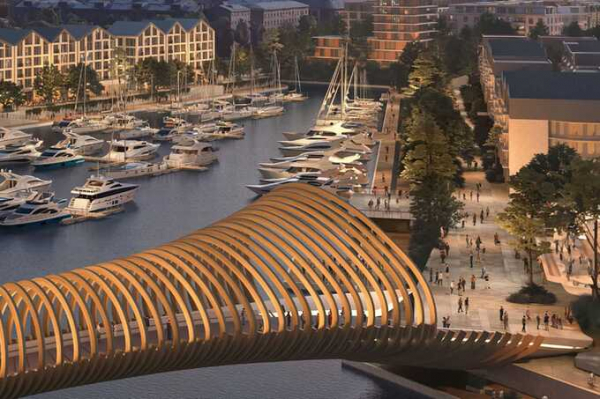

On May 18, SIA Riga Waterfront Investment Holdings — a subsidiary of the main developer of the “Northern Dubai” project — adopted a new version of its Articles of Association.
The document shows that the old oligarchic elite and Rietumu Banka have effectively secured total control over the future superprofits of the project. The price of this “investment paradise” for Latvia could prove extremely high: the scheme reportedly relies openly on selling “residency permit packages,” including to citizens of Syria, Pakistan, and Sierra Leone.
Documents reviewed by Kompromat.lv concerning SIA Riga Waterfront Investment Holdings demonstrate how, behind the façade of large-scale investment, there allegedly operates a legal conveyor whose clients include citizens of countries considered zones of elevated geopolitical and sanctions-related risk, willing to pay for documents at the cost of having virtually no rights within Latvian business structures.

Riga Waterfront is actively promoting the “Latvia Residency by Investment” program through real estate investments.
Two categories, two worlds
The story of this conveyor system is outlined in the new version of the company’s Articles of Association, approved at an extraordinary shareholders’ meeting on May 18, 2026. The document, signed by Egyptian citizen Hisham Mohamed Ibrahim Soliman, divides the internal structure of the holding into two completely separate universes.
In the first universe stands the parent company — SIA Riga Waterfront. By contributing a purely symbolic €20,776 to the share capital (less than one percent of the total amount), it secured Category A shares. According to clause 5.3 of the Articles, these modest contributions grant the parent structure 100% of voting rights and the exclusive right to receive all distributed dividends.
In the second universe are 23 foreign investors who contributed the remainder of the capital — exactly €2.3 million. Each invested a meticulously precise amount of exactly €100,000, receiving Category B shares in return.
From the perspective of classical capitalism, the deal appears economically absurd. Clause 5.4 of the new Articles directly deprives holders of Category B shares of voting rights and the right to receive dividends. Moreover, in the event of liquidation, they cannot claim any share in the appreciating assets of Andrejsala — they are promised repayment of no more than the same nominal €100,000. They are completely excluded from management and profits, while clause 9.2 even strips them of preemptive rights to buy each other’s shares.
This legal anomaly becomes easy to explain once Latvia’s Immigration Law is examined. The €100,000 figure is the exact statutory threshold established by Article 23 for obtaining a five-year European residence permit through capital investment.
Foreigners entering the Riga Waterfront project are not paying for a stake in a real estate development business. They are paying for the right to legally live and move within the Schengen zone, accepting the role of “silent wallets.”
Anatomy of asymmetry
Officially, the holding’s stated purpose sounds noble: “attracting financing for the implementation of the Project.” However, as always, the devil is in the details of the capital distribution structure, whose total volume is fixed at €2,320,776. According to the new version of the Articles of Association (Statūti), the company’s capital was divided in a rigid and highly asymmetrical manner.
Category A shares — the managerial core — account for only about 0.89% of the total capital, or €20,776. They belong entirely to the project’s parent company, SIA Riga Waterfront. These shares carry 100% of voting rights at shareholder meetings and — most importantly — the exclusive right to receive all dividends generated from commercial operations.
Each of the 23 foreign investors contributed exactly €100,000 to the capital, receiving an identical 4.3089% stake in the form of Category B shares (B kategorijas daļas). These shares provide no real operational control, as the Articles explicitly deprive their holders of voting rights and dividend rights. Even in the event of liquidation, they can expect at most the return of their nominal €100,000 investment, while all accumulated superprofits from Andrejsala’s future hotels, shopping centers, and marina infrastructure would go to the owners of Category A shares.
In addition, the Articles carefully outline mechanisms designed to prevent any loss of control over the project in the event of internal conflicts. Strategic decisions — including amendments to the Articles, changes in capital volume, issuance of new shares or options, issuance of debt securities, reorganization, liquidation, approval of annual reports, and profit distribution — require participation by 100% of the voting capital.
If a meeting fails due to lack of quorum, the Articles directly refer to Section 4.6 of the confidential Shareholders’ Agreement (Dalībnieku līgums). This only confirms that the real rules of the game, sanctions, and dispute-resolution mechanisms between the beneficial owners are hidden within a non-public shareholder agreement.
For ordinary matters that do not require unanimity, the Articles provide for the postponed meeting to be reconvened after 20 days, after which any participants who appear are deemed sufficient to form a quorum.
Geography under a “gray” flag
The €100,000 contributed by each of the 23 foreign investors to the capital of SIA Riga Waterfront Investment Holdings is far from accidental. According to data from Crediweb.lv, the geography of these investors who entrusted their money to the project represents a highly diverse international list of countries associated with elevated compliance risks.
Egypt: Mahmoud Abdelwahab Ahmed Abdelwahab Elawady, Sherif Elsaid Abdelhamid Ahmed Hammad, Khalifa Ossama Rabie Nasser Mohamed, Khalifa Rabie Nasser Mohamed, Ibrahim Mohamed Mostafa Ahmed, Salem Albasuoni Salah Mohamed;
Syrian Arab Republic: Rany Altahesh, Hany Bayour, Jowan Haji Osmaan, Wajdi Daamach;
Pakistan: Naeem Tariq, Dar Wasim Tariq;
Jordan: Abu-Laila Said, Rami Issa Ibrahim Alsharefeen;
as well as citizens of Bangladesh (Md Nure Alam Saboj), Belize (Ashwinkumar Vrajlalbhai Dhanak), and Sierra Leone (Mitsuru Okura).
What emerges is a legally flawless yet highly questionable conveyor system: wealthy citizens of third countries are “blindly” capitalizing a mega-development project in Riga while being entirely deprived of any ability to influence construction processes or claim operational income from the holding.
The introduction of “voiceless” Category B shares totaling €2.3 million directly coincides with the Riga Waterfront project’s marketing activity on the international market. According to immigration agencies — including NTL Trust — this development project is actively promoting the program “Latvia Residency by Investment.”
The scheme appears to be an ideal legal structure for attracting funds from foreign retail investors. Applicants for residence permits inject capital into the company and in return receive Category B shares. Investors obtain the legally required status of owning assets within the EU, yet remain legally isolated from the construction and financial processes of the holding.
From the perspective of Anti-Money Laundering, Counter-Terrorist Financing, and Counter-Proliferation Financing methodology (AML/CFT/CPF), the presented structure of SIA Riga Waterfront Investment Holdings represents a classic example of an entity that would warrant a High Risk classification. Any bank would be expected to ask the obvious question: “Could this structure be functioning as a nominee cover for the legalization of funds belonging to a pool of third parties under the umbrella of a well-known Emirati developer?”
The magic of fifty-five employees
For this conveyor system to operate without restrictions, the project’s lawyers reportedly had to account for another important barrier within Latvian legislation. The same Immigration Law states that if an investor places money into a small company, the number of residence-permit applicants is limited by a strict cap — no more than 10 people per company. To remove this limitation and transform fundraising into a mass pipeline, the company must satisfy the criteria of subparagraph “b” of Section 23(28), meaning it must employ more than 50 workers.
According to Crediweb.lv data, SIA Riga Waterfront Investment Holdings officially lists exactly 55 employees. For a structure whose business profile is limited to trading its own real estate and managing financial conduits, such staffing levels appear highly unusual. The company reportedly records a net loss exceeding €207,000 on turnover of €2.5 million, yet continues to maintain a workforce of more than fifty people.
For compliance analysts, this is considered one of the clearest indicators of artificially inflated staffing levels, allegedly necessary to ensure that Latvia’s Office of Citizenship and Migration Affairs (PMLP) can smoothly approve new applications from foreign buyers of Category B shares.
Dubai hub and the Syrian track
The geography of the investors would raise concerns for virtually any AML specialist. Among the 23 co-owners of Category B shares, particularly notable are groups of Egyptian citizens (6 people) and Turkish citizens (5 people). However, the greatest questions surround the four Syrian citizens, as well as two Pakistani nationals — a country traditionally associated with heightened AML monitoring.
At least two of the Syrian participants in the scheme, Rany Altahesh and Wajdi Daamach, reportedly obtained their passports not in Damascus, but through Syrian diplomatic missions in Abu Dhabi and Dubai.
The United Arab Emirates appears to play the role of an ideal transit hub within this structure. It is there that wealthy individuals from conflict zones in the Middle East and South Asia tend to accumulate. It is also there that the complex multi-channel chain of control over the Latvian business, allegedly tied to Mohamed Alabbar himself, ultimately converges. His Eagle Hills holding controls the Riga-based structure through an extensive network of parallel channels in the UAE, including the companies Symphony Global L.L.C., Jaona Investment L.L.C., and the private fund ANH Foundation.

Mohamed Ali Alabbar on Riga’s Alberta Street together with Leonids Esterkins and Emmanuil Grinshpun. Facebook: August 18, 2022.
In international practice, the use of closed Dubai-based funds at the top of a corporate pyramid is considered a textbook method for concealing the real source of wealth.
When even this camouflage proves insufficient, so-called “convenience passports” reportedly come into play. Thus, Latvia’s register unexpectedly lists as a co-owner of the Riga development project a man with the distinctly Japanese name Mitsuru Okura, who nevertheless presents a passport from the African republic of Sierra Leone. Another investor, Ashwinkumar Vrajlalbhai Dhanak, despite having a traditionally Indian name, reportedly enters Latvia under the flag of the Central American offshore jurisdiction of Belize.
Systemic blindness
From a legal standpoint, the “Andrejsala conveyor” appears to be protected almost flawlessly. In the Crediweb.lv system, next to the company’s name, there is a calm notation: “No sanctions risk identified.” The company carefully settles any obligations arising before Latvia’s State Revenue Service (VID) — as happened in August 2025, when an unexpected €185,000 tax debt was swiftly repaid within a month so as not to disrupt clients’ residence permit renewal procedures.
The organizers of the scheme pay taxes. In return, they allegedly receive silence from regulators and the ability to smoothly channel citizens of Syria, Pakistan, and Egypt into a closed corporate structure.
While the government publicly declares a policy of protecting the eastern borders and enforcing strict visa-flow controls, a commercial conveyor reportedly continues operating behind the façade of elite development on the Andrejsala waterfront — transforming security itself into a commodity with a fixed price tag.
Эстеркинс Леонид
Leonids Esterkins
Мадара Шкеле-Дупате
Madara Skele-Dupate
Шлесерс Эдвард
Slesers Edvards
Шлесерс Айнарс
Шлесерс Айнар
Ainars Sleser
Мухаммед Алаббар
Mohamed Alabbar
Рани Альтахеш
Rany Altahesh
Важди Даамаш
Wajdi Daamach
Naeem Tariq
Dar Wasim Tariq
Наим Тарик
Дар Васим Тарик
Hany Bayour
Jowan Haji Osmaan
Хани Байур
Джован Хаджи Осман
Саид Абу-Лайла
Abu-Laila Said
Nure Alam Saboj
Нуре Алам Сабодж
Ashwinkumar Vrajlalbhai Dhanak
Ашвинкумар Враджлалбхай Дханак
Mitsuru Okura
Мицуру Окура
Латвия
Сирия
ОАЭ
египет
Пакистан
Сьерра-Леоне
Белиз
Бангладеш
Иордания
SIA RIGA WATERFRONT
Riga Waterfont
Eagle Hills
Emaar Properties
ANH Foundation
ANH Investments Limited
Jaona Investment LLC
NTL Trust
Rietumu Banka
Офшоры
банки
миграция
TOP



Актуально


Copyright © 2026 http://topic-2.com
Email: [email protected]