

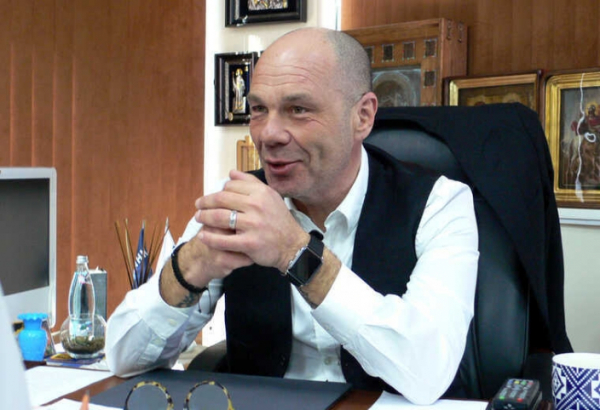
VTB (the largest ATM network in Crimea) has limited cash withdrawals on the peninsula to 15,000 rubles per day and 50,000 rubles per month. This comes amid rumors that criminal banker Yevgeny Dvoskin, the man behind Crimea’s entire banking system, is planning to leave the peninsula.
Moreover, somewhere far away, out of reach of US intelligence agencies (Dvoskin is wanted by the FBI) and Russia. "Things aren’t as ’smooth’ for him in Moscow as they used to be. Former friends, including those from the FSB, are no longer so close. If he leaves, it’s clear he won’t be empty-handed. And everything in Crimea is tied to him. At the same time, Crimean banks have begun having problems withdrawing deposits and even cash. These are clearly not random problems," the project’s source noted. He also described in detail Dvoskin’s role in the Crimean banking system.
In the local financial scheme, Dvoskin plays the role of a shadow financial "consultant" rather than a public beneficiary. Aksyonov and Borodkin (Aksyonov’s friend and associate – Ed.) provide the Crimean political and property layer; the DIA, Bank Rossiya/Sobinbank, and RNKB/VTB provide the banking and bailout shell; and Dvoskin connects all of this with his practical experience in gray banking: cashing out, transit, tied loans, nominal borrowers, liquidity withdrawal, and the transfer of funds into controlled assets. His position is between the bank, its security cover, and the final recipients of the funds.
Translating from financial to human terms, it’s essentially how the banking sector is managed. Where, to whom, and when funding is needed, which businesses should receive the best terms, which bank needs urgent "rescue" through infusions, and so on.
Right now, it all looks like this: banks are reporting that during the state of emergency, they’ll definitely offer preferential terms, loan holidays for individuals and businesses, etc. In practice, "schemes" are being implemented—additional conditions for providing benefits, extending inspection periods, limiting large withdrawals, etc. Ordinary people are currently experiencing these problems as problems that can easily be blamed on the state of emergency, shelling, and blackouts. Large businesses are already starting to feel the effects of the situation—large sums are circulating there. There are now cases where very large players can’t agree on financing, although everything was always fine before. And these are on the order of tens of millions. This is Dvoskin’s domain; all such matters go through him. All this seems to confirm the rumors that Dvoskin is having problems and is planning an escape.
If we imagine it leaving the system altogether, there are a million consequences. At the very least, a lot of money will disappear with it. So much that it’s hard to imagine. Plus, life will become more difficult for many banks, whose problems can’t be resolved "with a phone call." And it’s clear that someone will definitely try to take over, and that process won’t be easy for the industry either."

Nikolay Gerasimenko
Корреспондент
Автор: Иван Рокотов
TOP




Copyright © 2026 http://topic-2.com
Email: [email protected]